
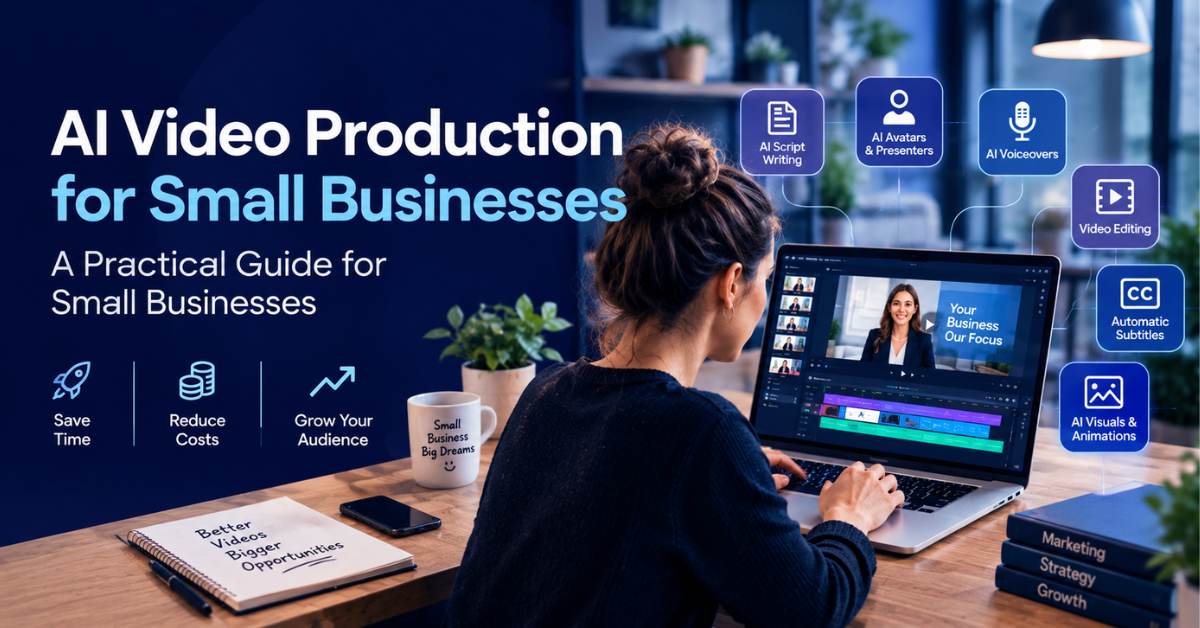
Video has become one of the most useful ways for small businesses to explain what they do, build trust and reach new customers. The challenge is that traditional video production can require considerable time, planning, equipment, editing and budget.
AI video production is changing that process.
Today, small businesses can use AI tools to help with everything from scripts and storyboards to voiceovers, video editing, subtitles, animations and even generating complete video scenes. This does not mean replacing creativity with automation. Instead, AI can take care of some of the more time-consuming production tasks while people remain responsible for the ideas, messaging, brand and final decisions.
What Is AI Video Production?
AI video production is the use of artificial intelligence tools throughout the video creation process.
Instead of producing every element manually, businesses can use AI to support different stages of production, including:
- Video script writing
- Storyboarding and planning
- Text-to-video generation
- AI presenters and avatars
- Voice generation and voiceovers
- Automatic subtitles
- Video editing
- Background removal
- Image and animation generation
- Video resizing for social media
- Repurposing long videos into short clips
For example, a small accountancy firm could create a short video explaining changes to business taxes. Rather than starting with a camera crew and several days of editing, the company could develop the script, create supporting visuals, add a professional voiceover and produce several versions for LinkedIn, YouTube and its website.
The technology is particularly interesting for smaller companies because AI can make certain types of production much faster and less expensive. Recent analysis of AI and copyright in the UK also recognises that generative AI can produce creative assets that previously could have been costly or time-consuming for smaller businesses to create.
Why Should Small Businesses Consider AI Video?
Large companies often have dedicated marketing teams, designers, videographers and production budgets. Small businesses usually do not.
That is where AI-assisted production can be useful.
1. Lower production costs
A traditional commercial video may involve filming, locations, cameras, lighting, actors, editing and post-production.
Not every business needs that level of production.
AI can help reduce the amount of manual work involved in simpler projects, particularly social media videos, explainers, product demonstrations and educational content.
This does not mean every AI video will be free or that professional production is no longer valuable. Paid AI platforms, professional editing and human creative work still have costs. The benefit is being able to spend those resources where they have the greatest impact.
2. Faster content production
One of the biggest advantages is speed.
A business can create a concept, develop a script and produce several content variations much faster than with a completely traditional workflow.
This is useful for businesses that need regular content rather than one major video every few months.
For example, a marketing agency could turn one client webinar into:
- A full YouTube video
- Five LinkedIn clips
- Several Instagram Reels
- Short educational videos
- Promotional snippets
- A website video
AI can help with parts of that repurposing process.
3. More content for social media
Social platforms have made video an important part of digital marketing.
Small businesses often know they should post videos but struggle to produce them consistently.
AI video tools can help businesses create different versions of the same idea for different platforms. A single concept can be adapted into a vertical Reel, a LinkedIn video, a YouTube Short or a website explainer.
The important point is not simply producing more videos. Each version should have a purpose and be suitable for the platform where it will appear.
4. Easier access to professional-looking content
AI tools can help smaller businesses create animations, graphics, subtitles and visual effects without having specialist software skills.
This can be particularly useful for businesses that need to explain something complicated.
For example, a software company could use animation to demonstrate how its platform works. A property company could create short videos explaining the buying process. A recruitment company could create videos answering common candidate questions.
How AI Video Production Works
A practical AI video workflow can be broken into several stages.
Step 1: Define the purpose
Start with the business objective.
Are you trying to generate leads, explain a service, introduce a product, answer customer questions or build brand awareness?
The objective should come before the AI tool.
Step 2: Develop the idea and script
AI can help generate initial ideas, headlines and scripts, but the business should provide the expertise.
For example, a solicitor should review legal information, while an accountant should check financial information.
AI can create a starting point, but subject-matter expertise gives the video credibility.
Step 3: Create the visuals
Depending on the project, businesses can combine existing footage with AI-generated images, animations, stock footage, screen recordings or generated video scenes.
The best approach will depend on the type of business.
Step 4: Add voice and sound
AI voice tools can produce narration in different languages, accents and styles.
However, businesses should think carefully about brand identity. A generic AI voice may work for an instructional video but feel inappropriate for a premium brand.
Where authenticity matters, a real human voice can still be the stronger option.
Step 5: Edit and add captions
Editing brings everything together.
AI-assisted editing can help with tasks such as removing unwanted sections, generating subtitles, identifying highlights and creating shorter versions.
Captions are particularly useful for social media because many people watch videos without sound.
Step 6: Review everything before publishing
This is one of the most important stages.
AI-generated videos can contain incorrect information, strange visuals, pronunciation problems or details that do not match the brand.
Human review should therefore remain part of the workflow.
What Types of Videos Can Small Businesses Create With AI?
AI video production can work across many industries.
Marketing videos
Businesses can create promotional videos for new services, seasonal campaigns and product launches.
Explainer videos
Complex products and services can be explained using animation, screen recordings and narration.
Social media videos
Short-form videos can be created for LinkedIn, Instagram, TikTok, Facebook and YouTube.
Training videos
Businesses can create internal training and onboarding content without organising a new filming session for every update.
Product videos
E-commerce companies can use video to demonstrate products, explain features and answer common questions.
Recruitment videos
Companies can create videos explaining their culture, vacancies, recruitment process and employee benefits.
Customer education
Businesses can answer frequently asked questions through a library of short educational videos.
AI Video Production vs Traditional Video Production
AI does not necessarily need to replace traditional video production.
In many cases, the strongest approach is a combination of both.
A business might use professional filming for its main brand video while using AI-assisted production for regular social media content.
Traditional production can be particularly valuable when authenticity, real people, locations and brand storytelling are central to the project.
AI is more useful when businesses need speed, multiple variations, simple animations, explainers or frequent content updates.
The right choice depends on the purpose of the video, not simply whether AI is available.
Important Copyright and Brand Considerations
Small businesses should not assume that anything generated by an AI tool is automatically safe to publish.
The European Commission’s IP Helpdesk advises businesses to check how AI tools handle inputs and outputs and to review generated content for possible intellectual-property issues. It also recommends paying attention to the terms of service of the AI platform being used.
The UK government has also published recent work on copyright and AI. Its 2026 report discusses circumstances where AI-generated outputs can potentially reproduce protected material and notes that AI-assisted works can receive copyright protection where human creativity and choices are involved.
For a small business, practical steps include:
- Check the commercial-use terms of the AI platform.
- Avoid uploading confidential customer information unnecessarily.
- Do not deliberately reproduce another creator’s copyrighted work.
- Check AI-generated visuals and audio before publishing.
- Keep records of important source material and permissions.
- Have a human review important claims and brand content.
The rules around AI and copyright continue to develop, particularly across the UK and EU, so businesses should obtain professional legal advice for high-risk or commercially significant projects.
Is AI Video Production Worth It for Small Businesses?
For many businesses, yes but only when it solves a real content problem.
AI is not a substitute for a good marketing strategy. Creating 50 poor videos will not necessarily produce better results than creating five useful ones.
The biggest opportunity is using AI to make video production more practical.
A small business can start with one useful video, measure how its audience responds and then build a repeatable production process.
For example, one monthly topic could become a long-form video, several short clips, a LinkedIn post, an Instagram Reel and a section of a blog article.
That creates more value from the same idea.
Final Thoughts
AI video production is making professional video content more accessible to small businesses.
It can reduce repetitive production work, speed up content creation and help businesses produce more video for websites, social media, advertising, training and customer education.
But the best results still depend on human input.
A strong concept, clear messaging, accurate information and good storytelling matter more than simply using the newest AI video tool.
For small businesses, the goal should not be to create videos because AI makes them easy to produce. The goal should be to use AI where it genuinely improves the production process while keeping human creativity, brand identity and quality at the centre.
FAQ’s
- What is AI video production for small businesses?
AI video production uses artificial intelligence tools to assist with different parts of creating a video, including script writing, voiceovers, visuals, editing, subtitles and content repurposing. It can help small businesses produce professional video content with less time and manual work.
- Is AI video production cheaper than traditional video production?
AI video production can reduce costs for certain types of content by reducing the need for filming, equipment and extensive editing. However, costs vary depending on the AI tools, level of human involvement and complexity of the video.
- What types of videos can small businesses create with AI?
Small businesses can use AI to create social media videos, explainer videos, product demonstrations, training videos, recruitment content, customer education videos and promotional content.
- Can AI video replace professional video production?
Not always. AI works well for many types of digital content, but professional video production can be more effective when authentic people, locations, detailed storytelling or high-end brand visuals are important. Many businesses can benefit from combining traditional production with AI-assisted workflows.
- What should businesses consider before using AI video tools?
Businesses should check the AI platform’s commercial-use terms, review generated content for accuracy and copyright concerns, protect confidential information and make sure the final video matches their brand. Human review is especially important for videos containing legal, financial or other important business information.
Comments are closed