When you search for a company on Google, you probably don’t think about how the search engine understands that company.
You see a name, website, reviews, social profiles and other information. Behind the scenes, however, search systems have to work out whether all of that information belongs to the same business.
This becomes even more important with AI search.
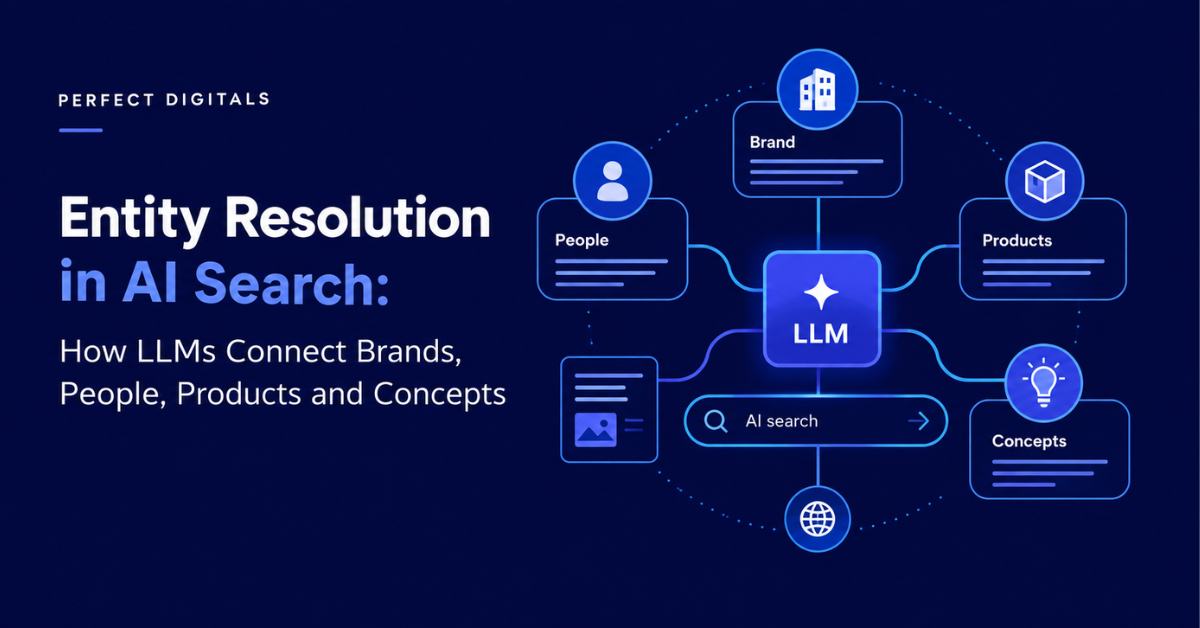
An AI system may receive information about a company from its website, business listings, articles, social profiles and other sources. It then has to understand whether those references describe the same company and how that company relates to products, people, services and topics. This process is known as entity resolution.
For businesses preparing their websites for AI search, understanding entity resolution can help explain why consistent business information and clear relationships between topics matter.
What Is an Entity Resolution?
Entity resolution is basically the process of figuring out which real-world thing a piece of information refers to.
Consider a company called “Mercury.”
A search for Mercury could refer to:
- Mercury the planet
- Mercury the chemical element
- A company called Mercury
- A product or software platform called Mercury
The name alone doesn’t tell the system which one the user means.
It needs additional information such as location, industry, website, description and surrounding content.
The same problem can happen with people and businesses that have similar names.
For example, imagine three companies called:
- Green Solutions
- Green Solutions Ltd
- Green Solutions Ireland
An AI system needs to determine whether these are three separate businesses or different references to the same organisation.
Why Does This Matter for AI Search?
Traditional search is heavily based on matching a user’s query with relevant web pages.
AI search has a different challenge.
Instead of simply showing ten links, an AI system may need to collect information from several sources and use it to produce an answer.
Imagine someone asks:
“Which digital marketing agencies in Ireland specialise in AI search for B2B companies?”
The system needs to understand several things at once:
- What counts as a digital marketing agency?
- Which businesses operate in Ireland?
- Which ones actually provide AI search services?
- Which ones work with B2B companies?
- Which information comes from reliable sources?
This is where entities become useful.
The system isn’t just looking for the exact phrase “AI search agency Ireland.”
It is trying to connect the business, service, location and audience behind the query.
Entity Resolution Also Connects Relationships
Identifying a company is only one part of the process.
AI systems also need to understand what that company is connected to.
For example:
Company → provides → SEO services
Company → operates in → Ireland
Company → works with → B2B businesses
Person → works for → Company
Person → writes → Article
Product → belongs to → Product category
These relationships give context to individual entities.
Think about the difference between these two statements:
“ABC Digital offers SEO.”
and:
“ABC Digital provides technical SEO services to B2B companies in Ireland.”
The second statement gives considerably more context.
It connects the company with:
- a service
- a market
- a location
That context can make the information easier for search systems to interpret.
Where Things Get Complicated
Businesses rarely have information in one place.
A company may have:
- Its main website
- LinkedIn profile
- Google Business Profile
- Industry directories
- Press mentions
- Partner websites
- Social media accounts
- Author profiles
- Review platforms
Over time, information can become inconsistent.
For example, a company may have changed its name but still have an old business directory listing.
Or its website may say it operates in Dublin, while an old profile still lists a previous office.
A service may have been discontinued but remain on an old profile.
None of these issues necessarily creates an immediate SEO disaster.
However, from an entity perspective, they create more information that a system has to reconcile.
This is particularly important for companies that have gone through rebranding, acquisitions, domain changes or major service changes.
How Structured Data Fits Into Entity Resolution
Structured data is one way websites can provide information about their entities in a machine-readable format.
For example, an organisation can provide information such as:
- Name
- Website
- Logo
- Address
- Contact details
- Social profiles
Google’s documentation states that Organisation structured data can help Google understand and disambiguate an organisation.
However, structured data should not be treated as a shortcut to AI visibility.
Adding Schema doesn’t automatically mean:
“Google understands my company now.”
The markup should reflect information that is actually present and accurate.
The website itself still needs clear content, sensible architecture and consistent information.
The Importance of sameAs
The sameAs property is particularly relevant when connecting an organisation or person with their official profiles elsewhere.
For example, an organisation could connect its website with its official LinkedIn page.
This helps establish that the external profile represents the same organisation.
But there is an important rule:
Only connect genuinely related profiles.
If a website lists random pages simply because they mention the company, those pages don’t suddenly become official identities.
For businesses, the better approach is to identify the important official profiles and keep them consistent.
Products Work the Same Way
Consider an ecommerce website selling a product with several versions.
For example:
Laptop X
- 8GB RAM
- 16GB RAM
- 512GB storage
- 1TB storage
- Silver
- Black
The website needs to make it clear which pages represent the main product and which represent its variants.
Google has specific structured-data guidance for product variants, including relationships between a product group and its individual variants.
This becomes increasingly useful as users ask AI systems detailed questions about products rather than simply searching for a product name.
How Businesses Can Improve Entity Clarity
You don’t need to rebuild an entire website to start.
Begin with a simple audit.
1. Check your company information
Is the business name consistent?
Is the official domain clear?
Are the location and contact details accurate?
2. Review your services
Are your main services clearly described?
Do your service pages explain who those services are for?
3. Check your people
Do important team members have clear profiles?
Are author names consistent?
4. Review external profiles
Check important business directories, social profiles and industry websites.
Look for outdated or conflicting information.
5. Connect related content
Use internal links to connect services, industries, people, case studies and relevant resources.
The objective isn’t to add links everywhere.
It is to help users- and systems interpreting the website — understand how the information fits together.
What Entity Resolution Does Not Mean
There is a lot of confusion around entity optimisation because the term is sometimes presented as another AI SEO trick.
It isn’t.
You don’t need to repeat your company name hundreds of times.
You don’t need to create a separate page for every possible entity.
You don’t need to add every Schema type available.
And there is no guarantee that creating perfect entity information will make an AI system mention your business.
AI search visibility depends on many factors, including relevance, content, retrieval, technical accessibility and the particular search system being used.
Entity resolution is better understood as making your online identity easier to understand, rather than trying to manipulate an AI answer.
Why This Matters for the Future of Search
Search queries are becoming more detailed. A user might once have searched:
“SEO agency Dublin”
Now they might ask:
“Which SEO agencies in Dublin work with B2B technology companies and have experience with AI search?”
The second question contains several connected requirements.
An AI system needs to identify businesses, understand their services, determine their location and match them against the user’s specific requirements.
That means businesses need more than pages targeting individual keywords.
They need clear information about who they are, what they offer and how their different areas of expertise connect.
Final Thoughts
Entity resolution may sound like a highly technical AI concept, but the practical idea is relatively simple:
Can a search system tell who you are, what you do and how the information it finds about you connects together?
For businesses, that means keeping company information consistent, clearly describing services and products, establishing genuine connections between people and organisations, and using structured data where appropriate.
As AI search becomes more capable of answering complex questions, this kind of clarity becomes increasingly valuable.
The goal isn’t to create an artificial identity for search engines.
It’s to make the real identity of your business easier to understand across the web.
FAQs
- What is entity resolution in AI search?
Entity resolution is the process of determining whether different references refer to the same real-world person, company, product or concept. AI systems can use contextual information and relationships to distinguish between similar entities.
- Why is entity resolution important for businesses?
It can help search systems make sense of information about a business across different pages and sources. Consistent names, services, locations and profiles make the business easier to identify and understand.
- Does Schema markup improve entity resolution?
Structured data can provide clear, machine-readable information about an organisation, person or product. Google says Organisation structured data can help it understand and disambiguate organisations, but it doesn’t guarantee rankings or AI search visibility.
- How can I improve my business’s entity information?
Start by checking your business name, website, services, locations, team information and important external profiles. Remove outdated information where possible, keep important details consistent and use appropriate structured data to describe the entities represented on your website.
Comments are closed